
Introduction
I have had patients spend months chasing wildly swinging blood sugars, tweaking doses, questioning their carb counting, before anyone thought to actually feel the skin where they inject. More often than people expect, the real culprit turns out to be a small, painless lump built up from injecting into the exact same patch too many times. It has a name, lipohypertrophy, and it is one of the most overlooked, easily fixed causes of unpredictable numbers in this whole condition.
Why one spot ends up doing all the work
Everyone drifts toward a favourite spot without meaning to, maybe a patch of the abdomen that is easy to reach one-handed, or simply a bit less sensitive than everywhere else. The trouble is that injecting into that same small patch, week after week, month after month, quietly changes the tissue underneath the skin there. That change is lipohypertrophy, and it builds slowly enough that most people never actually notice it happening.
What is actually forming under there
It is a build-up of thickened, lumpy fatty tissue, caused directly by repeated injections landing in the same small area. The lumps range from barely there to clearly visible and firm under your fingers, and here is the part that surprises people. They are almost always completely painless, which is precisely why they can sit there unnoticed for months or years. Insulin itself actually encourages fat cells to grow where it is repeatedly injected, and the constant needle trauma to one spot adds to that over time.
Why the lump matters more than it looks
The real issue is not appearance. It is behaviour. Insulin injected into lumpy tissue absorbs more slowly and far less predictably than insulin going into healthy fat, and that unpredictability can shift from one injection to the next even within the exact same lump. So the identical measured dose can act completely differently two days running, and that is often the real explanation behind blood sugar swings that seem to have nothing to do with food or activity at all.
How you actually catch it
Mostly by looking and feeling, checking the skin over your usual injection areas for lumps, firmness, or patches that feel thicker than the skin around them, something your diabetes team should be doing at every review and worth doing yourself now and then too. Often the first real clue arrives before you ever feel a lump, in the shape of blood sugar swings that no longer respond the way a dose used to, reliably, for no obvious reason.
Turn what you just learned into a daily habit — Flona helps you apply it to real meals and doses.
The fix is simply moving around, properly
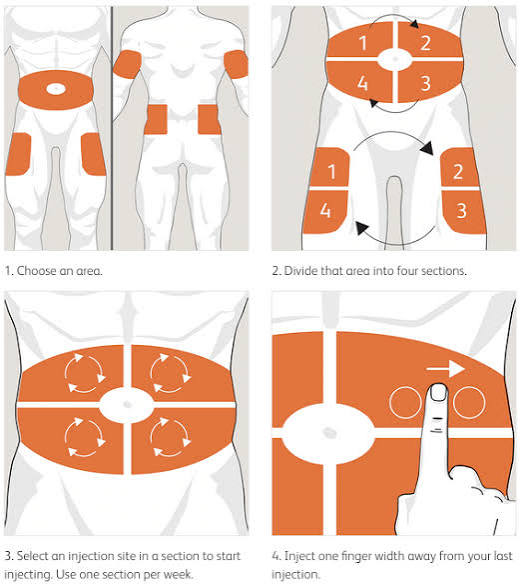
Preventing this comes down to rotating with an actual system rather than randomly. Picture each injection zone, the abdomen, a thigh, an arm, divided into a handful of sections, and work through them in a consistent order, shifting at least a couple of centimetres from your last spot each time and cycling through different zones over a week or a month. Spreading the work across a much wider stretch of skin gives every individual patch real time to recover between injections.
And if a lump has already formed
The main move is simply to stop injecting there and switch to healthy tissue elsewhere while the lump slowly settles, which can genuinely take weeks or months. Do this switch thoughtfully rather than casually, because healthy tissue often absorbs insulin noticeably faster and more efficiently than a lump your body had adapted to, which sometimes means the exact dose you needed while injecting into the lump now runs you lower than expected once you have moved away from it. That is exactly why a move off lumpy sites usually comes with a dose review alongside your diabetes team, not a silent switch.
Key points
- Lipohypertrophy is thickened, lumpy fatty tissue from repeated injections into the same small spot, and it is almost always painless, which is why it goes unnoticed.
- Insulin absorbed from a lump is slower and far less predictable, which is often the real cause behind unexplained blood sugar swings.
- A proper rotation system, shifting a couple of centimetres each time and cycling through zones, is what actually prevents it.
- Moving away from a lumpy site can genuinely change how your dose behaves, so it is worth a dose review with your team, not a silent switch.



Comments